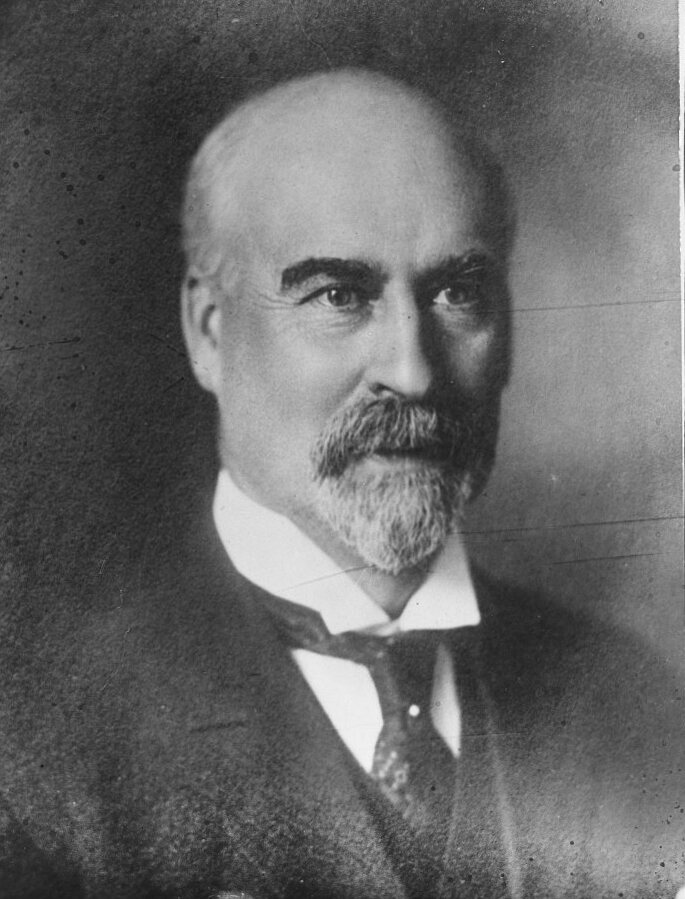
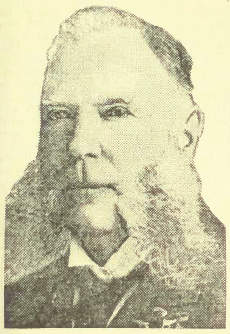
KAISER, Thomas Erlin
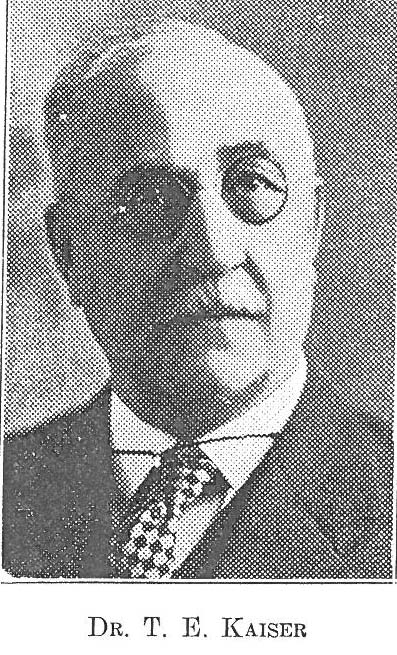
- Born
- 1863-02-16
Edgely, York County, Ontario - Died
- 1940-02-29
Oshawa, Ontario - Role
- Mayor of Oshawa 1907–1908; Member of Parliament (House of Commons of Canada) for the riding of Ontario, 1925–1930; physician; author of Historic Sketches of Oshawa (1921) and A History of the Medical Profession of the County of Ontario (1934)
Thomas Erlin Kaiser was a physician and a two-term mayor of Oshawa at the turn of the twentieth century, a Conservative member of the House of Commons through the last half of the 1920s, and the author of two books on his adopted county: Historic Sketches of Oshawa, the first substantial local history of the town, published in 1921, and a professional history of the county’s doctors that followed in 1934.
Early life and education
Kaiser was born at Edgely, a farm community in York County near Weston, on 16 February 1863. He was educated at Weston High School. His first occupation was schoolteaching; he taught in Etobicoke Township from 1883 to 1886. He then entered the medical faculty at the University of Toronto and held a militia commission with the 12th York Rangers during his student years, graduating with his Doctor of Medicine degree in 1890.
Oshawa medical practice
On completion of his degree, Kaiser set up his medical practice in Oshawa in 1890. The town was then still small, around four thousand people, but in rapid industrial growth driven by the McLaughlin Carriage Works, which in 1907 would evolve into the McLaughlin Motor Car Company and, in 1918, into General Motors of Canada. Kaiser’s practice covered both sides of that transition, from carriage town to auto town. He married Louise Lister on 26 December 1896. In 1912 he was appointed to the Ontario Board of Health, and in 1916, as the First World War drew on Canada’s medical manpower, he was made an honorary major in the Canadian Militia.
Oshawa municipal politics
Kaiser held a seat as an Ontario County councillor from 1902 to 1906. He served as Mayor of Oshawa for the 1907 and 1908 terms, and sat afterward on the town’s library, education, planning, and waterworks boards.
Orange Order
Kaiser held his Orange affiliation through Riverdale L.O.L. No. 2097, a Toronto lodge, reflecting that his lodge ties remained with his birth region even after two decades’ residence in Oshawa.
Historic Sketches of Oshawa
Kaiser wrote Historic Sketches of Oshawa and published it in 1921 through the Reformer printing house in Oshawa. The book is a compilation of material drawn from municipal records, personal reminiscence, and interviews with long-time residents. It remains in use as a primary source in Oshawa genealogical and local-history research; copies are held in most Ontario public-library local-history collections and have been digitized by the Internet Archive and HathiTrust. In 1934 Kaiser followed it with A History of the Medical Profession of the County of Ontario, drawing on his own four decades of practice and his Ontario Board of Health service to chronicle the doctors who had worked the county alongside him.
Federal politics
The federal riding of Ontario was created in 1924, carved out of the former riding of Ontario South, and covered Pickering, Whitby East and West, Reach, and Scugog townships together with the city of Oshawa. In the 1925 general election, held that October, Kaiser stood for the new riding as the Conservative candidate and won it, becoming its first Member of Parliament and taking a seat in the 15th Canadian Parliament in Ottawa. He was returned again in the 1926 election and sat through the 16th Parliament. In the 1930 general election, held as R. B. Bennett’s Conservatives swept to power nationally, Kaiser nonetheless lost his own seat to the Liberal candidate William Henry Moore, ending his five years in the House of Commons.
Death
Kaiser died at Oshawa on 29 February 1940, at the age of seventy-seven, thirteen days after his last birthday. Nineteen forty was a leap year, giving him one of the less common death dates on the calendar.
Trace Your Orange Roots
Surname matches, haplogroup placement, and living relatives. FamilyTreeDNA's testing kits pick up where archival records on the Kaiser line end.
Affiliate links. We earn a small commission at no cost to you. Full disclosure →
Sources
- Thomas Erlin Kaiser — Wikipedia — Sourced to the Canadian Parliamentary Guide (Normandin, 1929); confirms federal House of Commons service (not provincial), marriage, education, and second book title. Verified 2026-07-12.
- Ontario (electoral district) — Wikipedia — Confirms Kaiser as the riding's inaugural MP (15th–16th Parliaments, 1925–1930), created in 1924 from Ontario South and covering Pickering, Whitby East and West, Reach, and Scugog townships plus the city of Oshawa; and his defeat in 1930 by Liberal William Henry Moore. Verified 2026-07-12.
- Legislative Assembly of Ontario — Members' roster — Checked 2026-07-12: no record exists for Kaiser as an Ontario MPP, confirming his 1925–1930 seat was federal, not provincial.
- Kaiser, T. E. Historic Sketches of Oshawa. Oshawa: Reformer Printing, 1921. — Kaiser's own book on the town; a primary-source local history and a contemporary account of his civic milieu.
- Kaiser, T. E. A History of the Medical Profession of the County of Ontario. 1934. — Kaiser's second book, a professional history of Ontario County's physicians drawing on his own decades of practice and militia medical service.
- Oshawa Public Library — Local History Collection — Holds Kaiser family materials, Reformer newspaper archives, and council minutes from his mayoralty.
- Canadian Parliamentary Guide, 1926–1930 editions
Further reading
As an Amazon Associate we earn from qualifying purchases. Full disclosure →
- A History of the County of Ontario — Leo A. Johnson. Corporation of the County of Ontario, 1973.
- The Sash Canada Wore: A Historical Geography of the Orange Order in Canada — Cecil J. Houston and William J. Smyth. University of Toronto Press, 1980.