GUTHRIE, Percy Albert
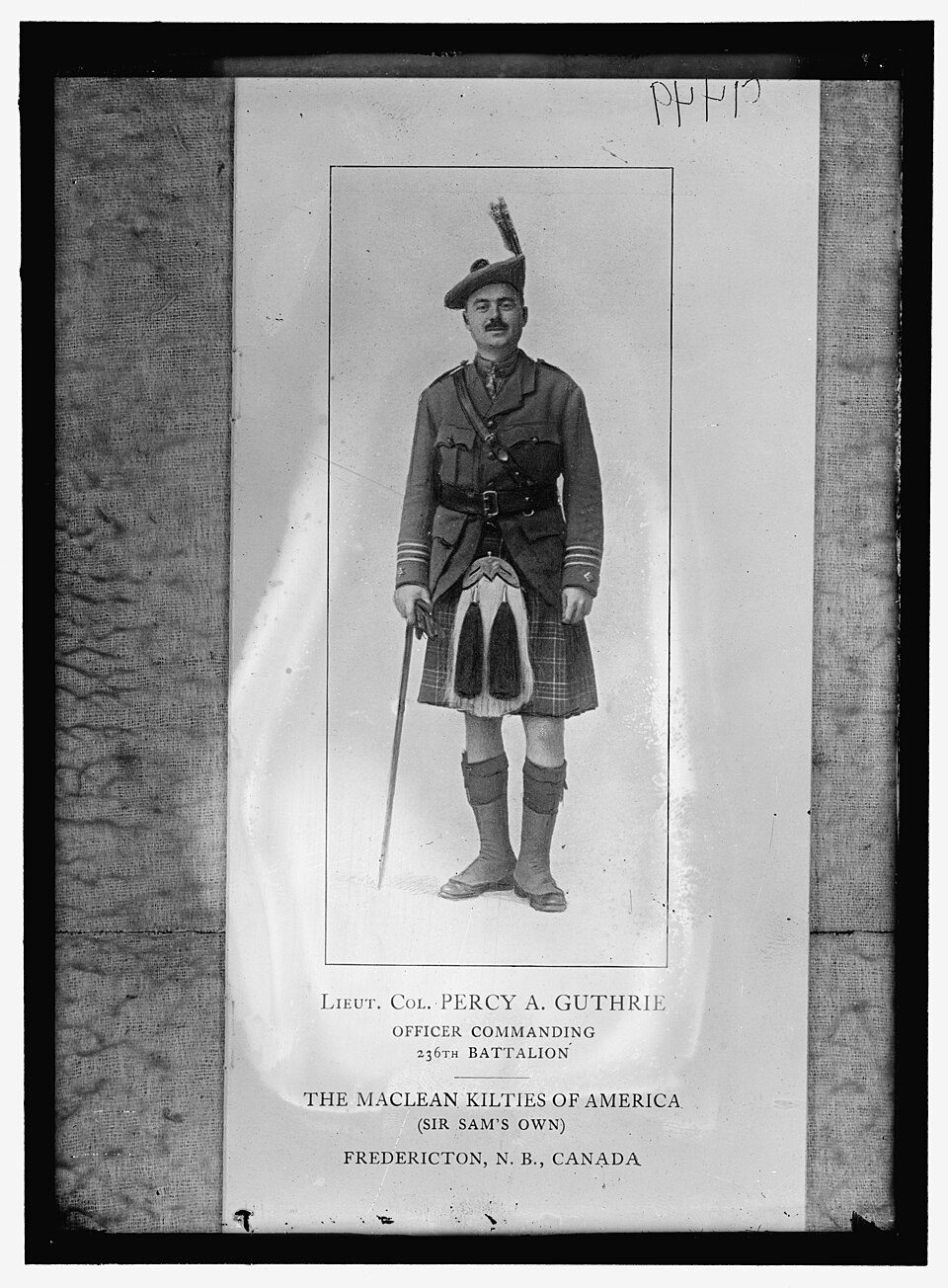
- Born
- 1884-06-20
Oromocto, New Brunswick - Role
- Lieutenant Colonel, 236th Battalion, Canadian Expeditionary Force; Member of the New Brunswick Legislative Assembly for York 1914; barrister
Percy Guthrie was wounded in eleven places by a shell at Festubert, invalided home on a liner that a German submarine then torpedoed, found floating in the North Atlantic holding on to his own crutches, and went back to New Brunswick to raise a Highland battalion. He was a lawyer, a sitting member of the provincial legislature, and a member of Graham L.O.L. No. 20 at Fredericton. This page recovers his biography from the archived original at guthrie.php, which went offline with the rest of the old Canadian Orange Historical Site and survives only in the Internet Archive.
Fredericton and the legislature
He was born at Oromocto, New Brunswick, on 20 June 1884. He practised law and belonged to Graham L.O.L. No. 20, the Fredericton lodge that Thomas Hill founded on 5 July 1844, which by Guthrie’s day was the senior Orange lodge in the province.
In 1914 he was elected to the New Brunswick Legislature as a Conservative for York. The riding returned two members, and the other seat went to a fellow Orangeman, Harry McLeod.
Festubert
Guthrie went overseas and joined the 10th Battalion, the Calgary unit whose ranks had been cut apart at St. Julien. The archived page reproduces his own account of his first day with it, which is worth reading as the only first-person voice in the record:
The air was absolutely full of whistling bullets and shrieking, whistling and crashing shells. I had the men on each side of me shot dead. At practically the same instant I saw six men blown to bits a few yards away. I saw arms and legs torn off by shell explosions all along the line.
He took over the battalion on the afternoon of 25 April 1915 when it separated again from its amalgamation with the 7th Battalion, and commanded it through the Festubert fighting. On 25 May 1915 a shell burst at his feet and wounded him in eleven places. His own words again: “I then got over the stunned feeling and looking down saw that my clothing was torn away and blood gushing from several places.”
He was declared unfit for further service and invalided home.
The Hesperian
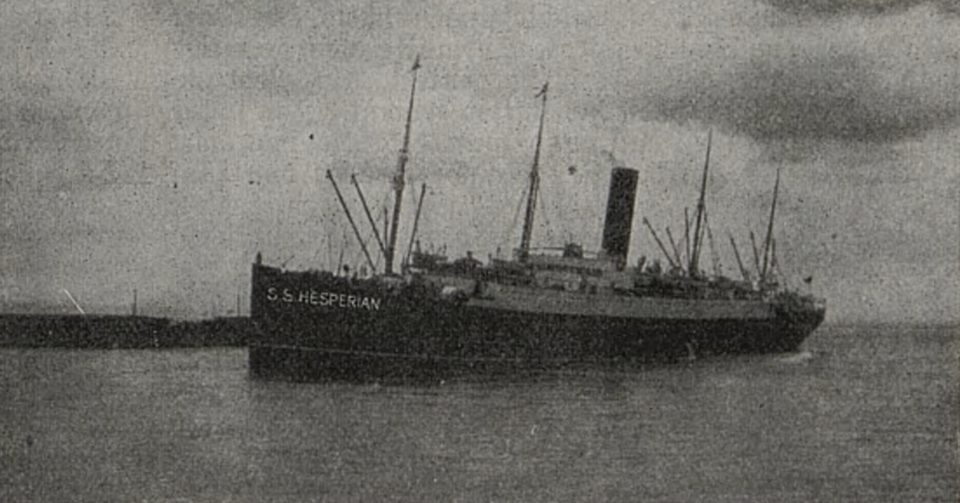
The ship carrying him home was the Allan Line’s Hesperian, a 10,920 ton twin-screw liner built by A. Stephen and Sons at Glasgow in 1907 and launched on 20 December that year. On the evening of 4 September 1915 she was struck by a torpedo from U-20, the same submarine that had sunk the Lusitania. She stayed afloat long enough for most of her passengers to reach the boats, was taken in tow, and sank on 6 September about 130 miles west of Queenstown. Thirty-two people died.
The Lethbridge Daily Herald of 8 September 1915, reprinted in full on the archived page, carried Guthrie’s own account. He was in bed when the ship was hit. After reaching the deck he went back to his cabin for lifebelts and fitted them to some women, then went down again for Lieutenant Riley, who could not walk. Captain Geggie helped him back up. Unable to stand on a broken ankle and separated from his crutches, he was dragged to the rail by a Miss Harvey, who found the crutches again, and was pushed by her and pulled by Major Barre into a lifeboat, narrowly missing a fall into the sea. The boat nearly capsized as it was lowered and its plug came out, until a Canadian private got it back in. Guthrie named Miss Harvey, Major Barre and Captain Geggie for their work helping women into the boats. He reached Liverpool with a broken ankle and the temporary loss of sight in one eye.
The archived page’s second telling of the same episode adds the detail that has followed Guthrie ever since: he was found floating on the sea supported by his crutches.
Raising the 236th
The idea for a Highland battalion from New Brunswick came to Guthrie while he lay in No. 2 Canadian Stationary Hospital in France and heard the pipes of a Scottish battalion going up the line. He said afterwards that both Prime Minister Sir Robert Borden and the Minister of Militia Sir Sam Hughes had promised him help while he was in hospital, which is where the battalion’s nickname “Sir Sam’s Own” came from.
The 236th Overseas Battalion came into existence on 15 May 1916 as the New Brunswick Kilties, though its own correspondence and newsletter called it the MacLean Kilties from the start. It was not allowed to recruit until six other battalions had filled their ranks, because the officer commanding feared that a unit with pipes and kilts would be too popular. When recruiting did open, on the first day a girl in Clan MacLean tartan opened meetings at fifteen locations at eight o’clock by reciting “Fire the Pile on Craig-Gowan Height”, and bonfires were lit on the nearest summits. A fiery St. Andrew’s Cross was carried around the province by car, horse and foot. Most of the unit’s officers and non-commissioned officers were wounded overseas veterans, which the archived article treats as the reason raw recruits found them convincing.
The tartan was MacLean of Duart. The archived article gives three reasons for the choice: the best-known military man in the province was Brigadier General H. H. MacLean, a patron named in the battalion newsletter was Lieutenant Colonel Angus McLean, who funded the kilts, and Guthrie’s own mother was a MacLean.
New Brunswick could not fill the battalion. Dominion-wide recruiting was tried and cancelled after two months when other battalions complained. The unit then turned to New England, where large numbers of Maritimers were working and the United States had just entered the war, renamed itself the MacLean Kilties of America, and signed up more than 1,600 recruits in eleven days. Over 1,300 applications came from Boston alone. American-born applicants were passed to United States recruiters and others were funnelled to different units, leaving the Kilties themselves with over 500 men. Guthrie made a recruiting speech before a Red Sox and Detroit Tigers game and presented a swagger stick to Ty Cobb.
Meanwhile the battalion had established itself in Fredericton and refurbished Old Government House as a barracks and training headquarters, on the understanding that after they left it would serve as a convalescent home for wounded veterans. The building is now the residence of the Lieutenant Governor of New Brunswick.
The battalion, 1,087 strong, sailed for England on His Majesty’s Troopship Canada and reached Liverpool on 19 November 1917, taking a final name, the 236th O.S. Battalion, C.E.F. MacLean Highlanders. At Seaford Camp it was inspected by Sir Donald Fitzroy Maclean, Chief of Clan Maclean, who presented two pipe banners. It was passed fit for France by the end of February 1918 and crossed in March. It was then broken up and its men used as reinforcements, despite protests from the officers, the men, Scottish associations in Canada and the United States, and the British Consul General in Boston. New Brunswickers could join the New Brunswick Regiment and most of the rest went to the Black Watch, Royal Highlanders of Canada, in the 20th Canadian Reserve Battalion. One of them, Charles Cromwell of New Brunswick, piped the advance into Mons on the morning of 11 November 1918.
The Empire Club address
On 2 November 1916, in the middle of the recruiting campaign, Guthrie spoke to the Empire Club in Toronto. The archived page reprints the address at length. He addressed the audience as “my friends in Orange Toronto”, said “I am an Orangeman myself and am proud of it”, and used the platform to argue against sectarian and linguistic division in the war effort. The passage the old site clearly kept the speech for is this one:
Coming down on a trench line on the afternoon of the 22nd May, before we made the smash when we took the 425 yards at Festubert, I saw a Roman Catholic counting his beads, and I pressed with the Orange grip the hand of my Orange brother crawling through the mud, and they were not asking one another anything about bilingualism or any racial feuds or differences.
He told the club that a man fighting in France was fighting for Canada rather than for England or for France, and that if the line broke the enemy would be six days from Canadian shores. He described himself as having been practising law in Fredericton the day before, making a humble living for a wife and three children, and fighting in France the next.
After the war
Guthrie moved to the United States and practised law in Boston, Massachusetts. The archived page gives his death as 1948 and adds no place.
Where the record is inconsistent
The archived page contradicts itself on two points and it is better to record that than to pick a reading.
It calls him “Major Percy Guthrie of the 10th Battalion” in one paragraph and “Major Percy Guthrie of the 7th Battalion” in another. Both are defensible, because the 7th and 10th were amalgamated in late April 1915 and separated again on the 25th, but the page never says so plainly.
It also gives his birth as 20 June 1884 and describes him as “the 33 year old officer” invalided home in December 1915, which would make him 31. One of the two is wrong and the page gives no way to decide.
The page carries two full retellings of the Festubert wounding and the Hesperian rescue in near-identical words, which is the ordinary result of a page assembled from several clippings over time rather than any dispute in the record.
Where to look next
Guthrie’s Canadian Expeditionary Force personnel file is held by Library and Archives Canada and will carry his attestation paper, next of kin and medical records, none of which the archived page reproduces. The 236th Battalion’s war record is cited in the archived article and survives in print.
For the lodge, Graham L.O.L. No. 20 at Fredericton is the oldest in the recovered New Brunswick record, and its founder’s life is at Canadian Orange biographies recovered from the archive, which also lists the other Canadian Expeditionary Force commanders the old site’s compilations name. For the Order’s wartime role more generally see the Orange Order in Canada, and for a later Orangeman whose war record is documented rather than reconstructed, John Weir Foote, the chaplain who won the Victoria Cross at Dieppe. Men who died in service and were buried under Orange auspices appear throughout the recovered obituary index, including Colour-Sergeant Gunn Newell of Warwick, the first man from Lambton County killed in the war.
Trace Your Orange Roots
Surname matches, haplogroup placement, and living relatives. FamilyTreeDNA's testing kits pick up where archival records on the Guthrie line end.
Affiliate links. We earn a small commission at no cost to you. Full disclosure →
Sources
- Percy Albert Guthrie, M.P.P., canadianorangehistoricalsite.com — The archived original page, recovered from the Internet Archive and read 2 August 2026. It is the source for Guthrie's birth date and place, his membership of Graham L.O.L. No. 20, his 1914 election for York, his Festubert wounding, the Hesperian rescue, his command of the 236th, and his move to Boston. It also reprints a Lethbridge Daily Herald report of 8 September 1915 and an Empire Club address of 2 November 1916.
- The MacLean Kilties, by Ian MacLean, reproduced on canadianorangehistoricalsite.com — An article on the raising of the 236th Battalion reproduced in full on the archived page, credited there to Ian MacLean and citing the battalion war record and E. S. Garner in Crown Imperial no. 46, Spring 1987. Source for the recruiting campaign, the Old Government House barracks, the Boston enlistments, the sailing on HMT Canada and the breaking up of the battalion in 1918.
- Guthrie, Percy A., Lt. Col., 236 Battalion, Canada, The MacLean Kilties of America — Harris and Ewing glass negative, 1917, Library of Congress catalogue 2016868379. An independent record confirming Guthrie's rank, battalion number and the MacLean Kilties of America name. Verified 2 August 2026.
- Canadian Orange Biographies 8, canadianorangehistoricalsite.com — Source for the founding of Graham L.O.L. No. 20 at Fredericton by Thomas Hill on 5 July 1844, the lodge Guthrie later belonged to. Read 2 August 2026.
Further reading
As an Amazon Associate we earn from qualifying purchases. Full disclosure →
- Welcome to Flanders Fields: The First Canadian Battle of the Great War — Daniel G. Dancocks. Background on the 10th Battalion in 1915, the formation Guthrie was serving with at Festubert.