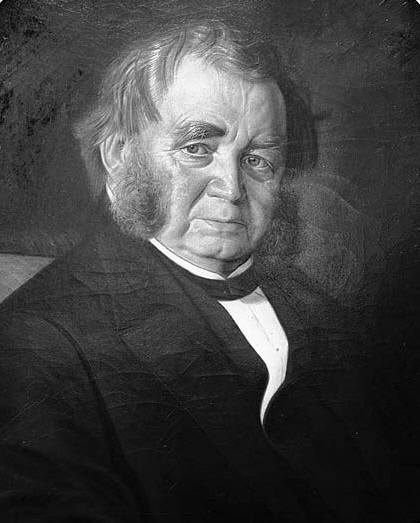
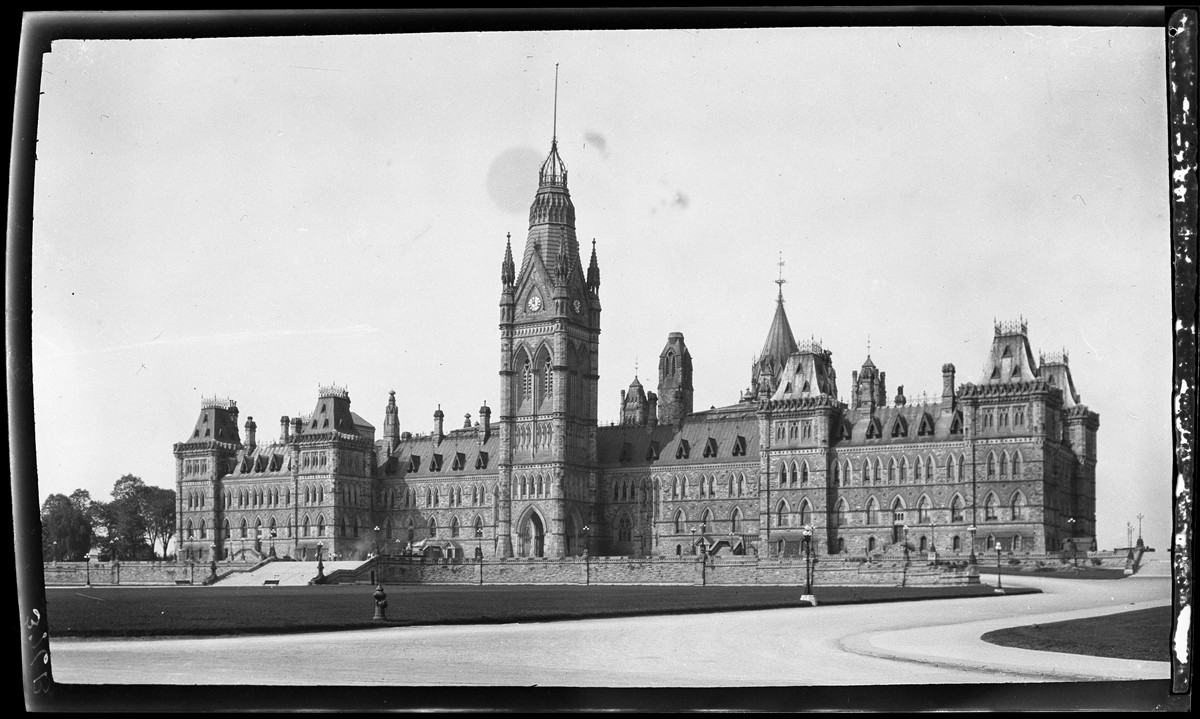
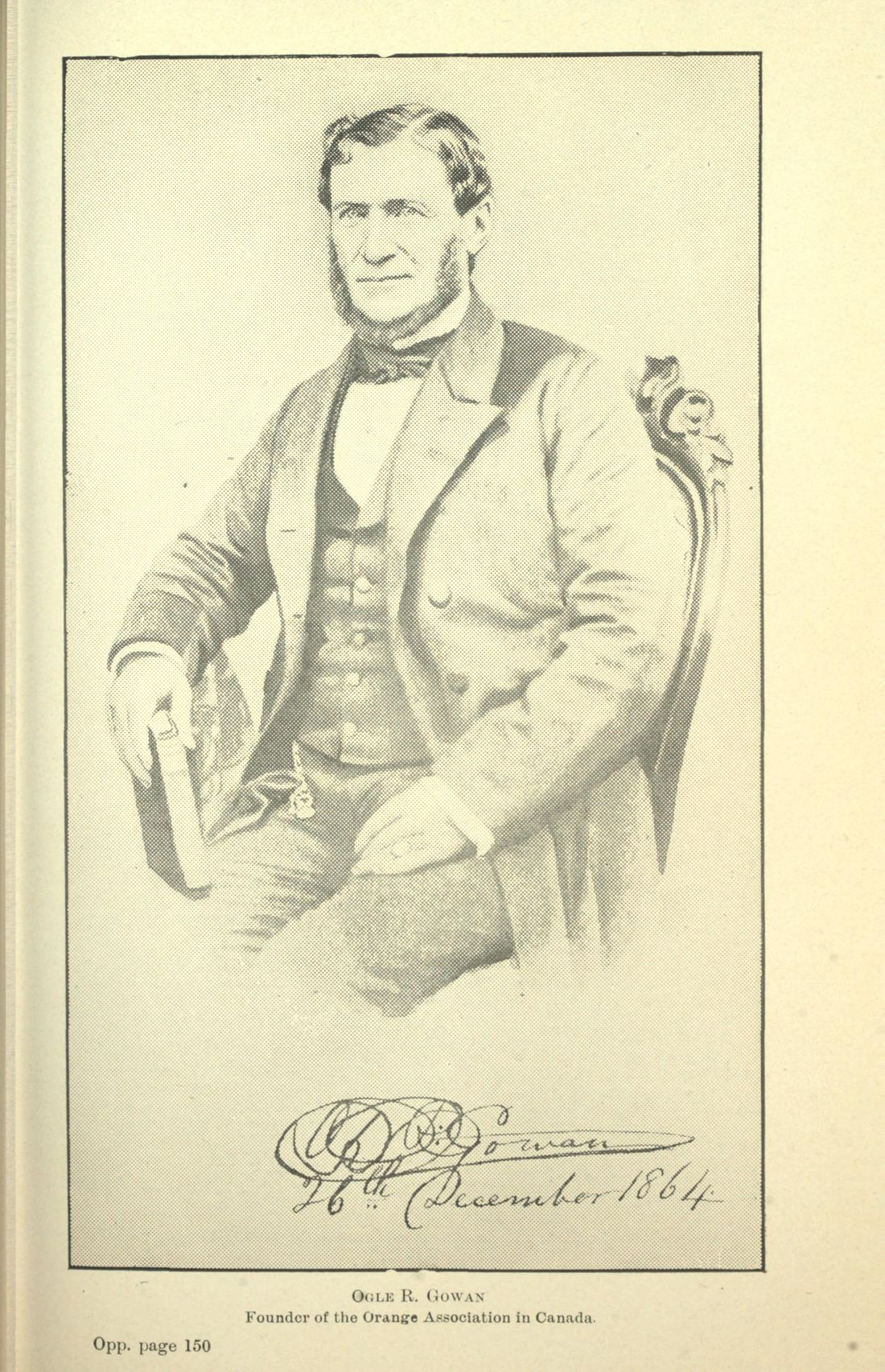
GOWAN, Ogle Robert
- Born
- 1803-07-13
Mount Nebo, County Wexford, Ireland - Died
- 1876-08-21
Toronto, Ontario - Role
- Founder and first Grand Master of the Grand Orange Lodge of British North America, 1830; Member of the Legislative Assembly of the Province of Canada for Leeds, Leeds and Grenville, and North Leeds; proprietor of the Brockville Statesman and the Toronto Patriot; Lieutenant-Colonel, Queen's Royal Borderers
Ogle Robert Gowan called the meeting that built the Orange Order in Canada, and then spent the next forty-six years being distrusted by nearly everyone he needed. He founded the Grand Orange Lodge of British North America at Brockville on 1 January 1830, sat in the Legislative Assembly under four different constituency names, took two musket wounds at the Battle of the Windmill, ran four newspapers of which one survived, held the grand mastership twice, lost it twice, and broke the Order in half in 1853 to get it back. Hereward Senior, who wrote both the standard scholarly account of Canadian Orangeism and Gowan’s entry in the Dictionary of Canadian Biography, called him the most impressive of all Canadian Orange grand masters and also recorded that most Reformers and nearly all Compact Tories thought him disreputable. Both judgments are defensible on the record.
Wexford, 1803 to 1829
He was born on 13 July 1803 at Mount Nebo in County Wexford, the sixth son of Hunter Gowan, a landlord, magistrate and captain of the Wexford yeomanry, and Margaret Hogan. He was educated at home. His godfather was George Ogle, an early grand master of the Irish Orange Order, and Gowan was initiated as an Orangeman in County Wicklow in 1818, at fifteen.
In Dublin he went into political journalism with George Perkins Bull, publishing a paper called the Antidote, and wrote anti-Catholic tracts including a long address to the Marquis of Wellesley, then Lord Lieutenant. His substantial early work was The Annals and Defence of the Loyal Orange Institution of Ireland, published in Dublin in 1825. When the Irish lodges dissolved that year under legislative pressure, Gowan became assistant grand secretary of the successor body organised by Sir Harcourt Lees, the Benevolent and Loyal Orange Institution of Ireland. That office kept up a correspondence with Orangemen in British North America, so his name reached Canada before he did.
Two things travelled with him from Wexford. One was a working knowledge of mass politics learned by watching Daniel O’Connell’s Catholic Association operate, which is why Gowan was better at organising ordinary Protestant farmers than any of the gentlemen who later replaced him. The other was George Perkins Bull.
Brockville, 1 January 1830
Gowan emigrated in 1829 and settled at Escott Park in Leeds County, Upper Canada, with a household of nine including two servants. He farmed on a comfortable scale and cared about provincial politics considerably more than about farming.
Scattered Orange lodges already existed in the colonies, brought over by British regiments and by Ulster emigrants, but they answered to nobody in particular. Gowan’s contribution was to see that this was the whole problem. He summoned representatives of lodges in Upper and Lower Canada to the Brockville courthouse on 1 January 1830, and that meeting constituted the Grand Orange Lodge of British North America with Gowan as deputy grand master. The Duke of Cumberland was invited to be grand master and declined; after some negotiation Gowan took the office himself and became the first Canadian grand master.
Four newspapers, one of them viable
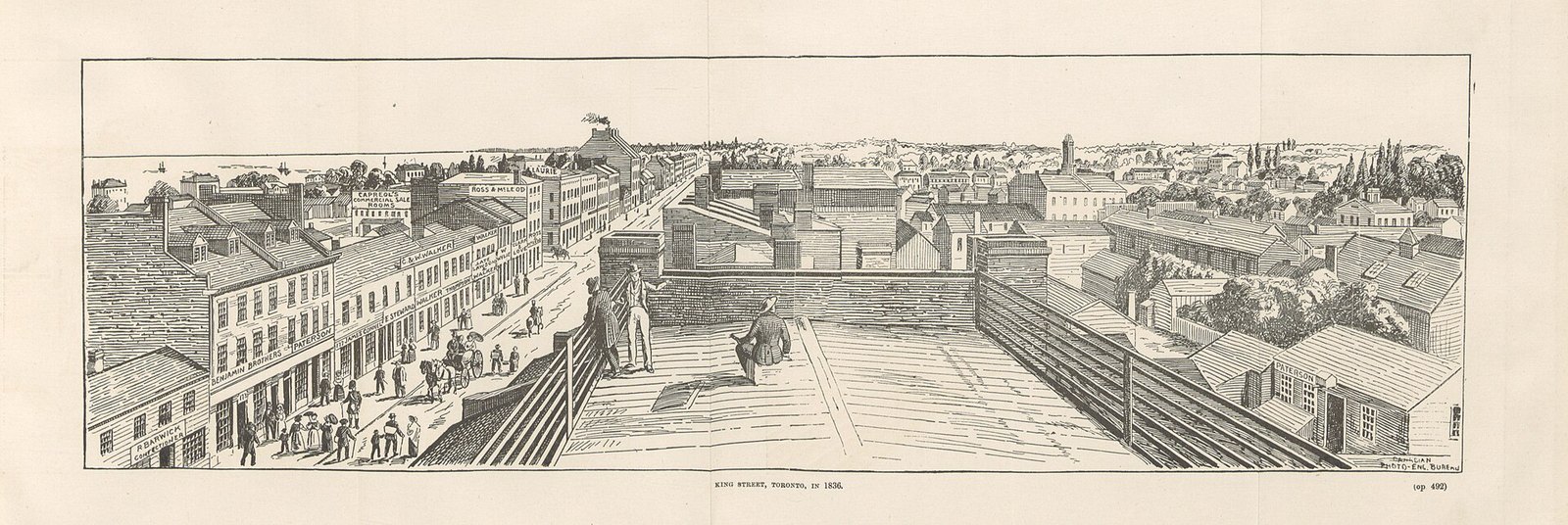
Gowan believed a politician without a press was a politician without a voice, and it took him three failures to find a paper that paid. He founded the Brockville Sentinel in 1830 and renamed it the Antidote in 1832 after the Dublin paper; it struggled throughout. He took over the Brockville Gazette in December 1831, issued a handful of numbers, and let it lapse until an Orangeman named Arthur McClean picked it up in July 1832. Only the Brockville Statesman, founded in 1836, worked. He ran it for sixteen years, used it to publish the letter on responsible government that cost him a government post, used it to attack a governor general in 1849, and shut it down in early 1852 when he left for Toronto.
Leeds: elected, unseated, elected, unseated
His first campaign, in 1830, was fought as an independent “immigrant” candidate appealing to Protestants and Catholics alike, and he lost. Refusing to run in harness with the Tory Henry Sherwood offended the Perth Orangemen, who went after him in the Tory Brockville Gazette on nativist grounds, which is a useful early indication of how little the Order’s Canadian members agreed with each other.
By 1834 he had built a machine. Part of it was ordinary lodge organisation and part of it was securing title deeds for immigrant settlers, which turned them into voters. He was elected for Leeds in 1834 and again in 1835, and on both occasions the election was invalidated because of Orange violence at the polls. He lost a by-election early in 1836 and finally won and held a seat that summer, after Lieutenant Governor Sir Francis Bond Head dissolved the assembly. By then he had assembled the Orange and Roman Catholic voting alliance he had been working toward since 1832, with the grand lodge welcoming what it called manifestations of loyalty from Catholics and Bishop Alexander Macdonell acknowledging unequivocal and substantial proof of disinterested friendship from Orangemen. The man remembered as a sectarian organiser spent much of the 1830s cutting deals with the Catholic bishop.
The rebellion, and two wounds at the Windmill
When rebellion broke out in Lower Canada in the late autumn of 1837, Gowan raised a volunteer company at Brockville called the Invincibles and was made captain in the 2nd Regiment of Leeds militia. In 1838 he commanded a Queen’s Own Rifles company at the capture of Hickory Island near Gananoque. Promoted lieutenant-colonel of a provisional militia battalion, he was wounded twice at the Battle of the Windmill near Prescott later that year and was thanked in general orders. His battalion was given the honour name Queen’s Royal Borderers, a title he attached to his own name on title pages for the rest of his life.
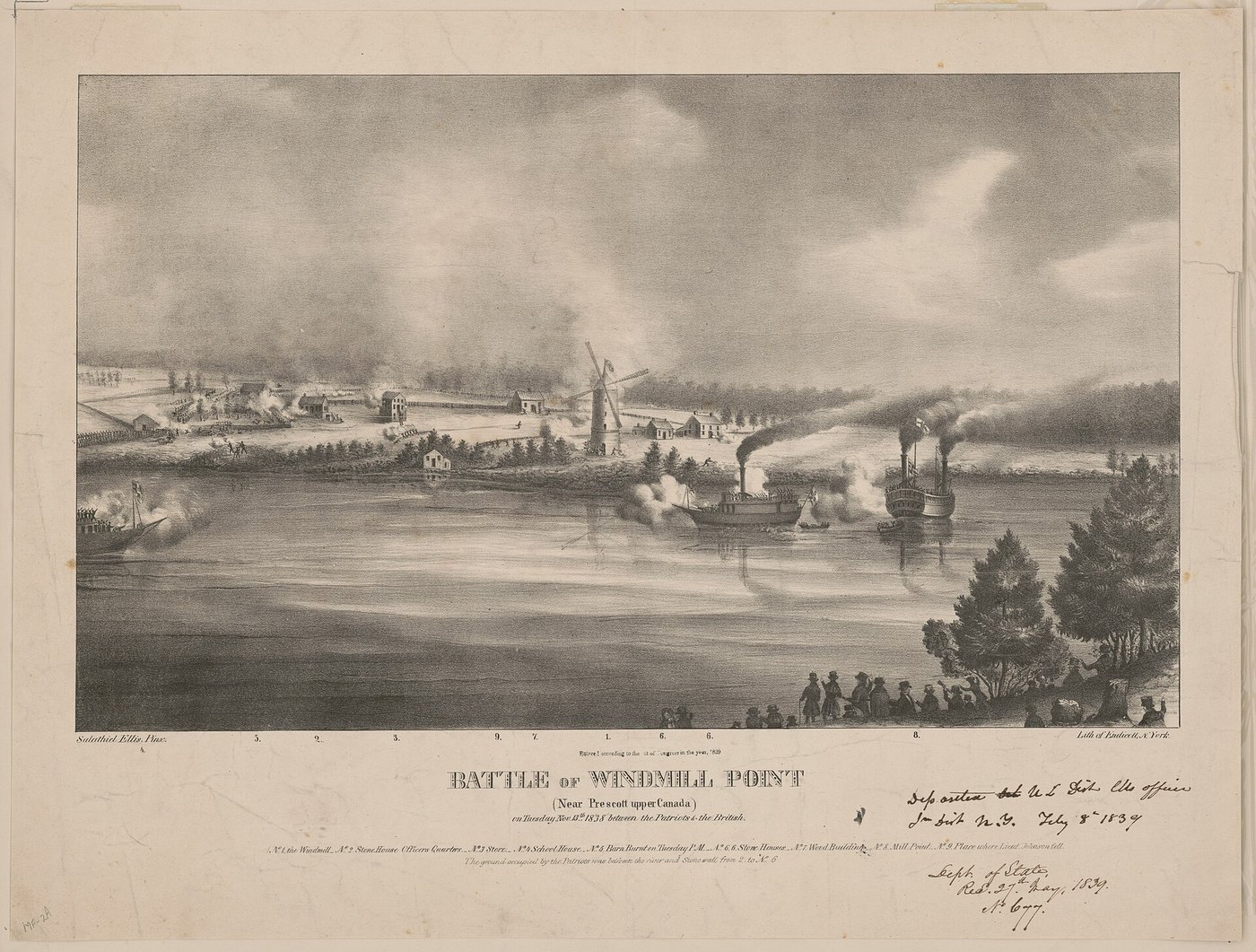
The reward was not what he expected. Orange lodges in the United Kingdom had dissolved in 1836 under the threat of anti-Orange legislation, and Head hoped the Canadian lodges would follow. Most refused, and Gowan’s grand lodge refused loudest. The government then declined to acknowledge Orange service in the rebellion publicly at all, and Gowan, having just been shot twice for the Crown, drew the obvious conclusion and began drafting a reform platform.
Responsible government, and the price of saying so
In 1839 he published a letter on responsible government in the Statesman. Francis Hincks, a Reformer, thought enough of it to reprint it as a pamphlet, which is how a letter by an Orange grand master became a document of the reform movement. Gowan was removed from his post as agent of crown lands in the Johnstown District for it. On 8 April 1839 he introduced a bill to divide the clergy reserves among all legally recognised denominations, and Tory Orangemen began pressing for his removal as grand master. He dropped both initiatives under pressure without repudiating either.
The Baldwin and La Fontaine ministry then went after the Order directly. A bill introduced by Robert Baldwin in 1843 would have barred Orangemen from crown office and jury service and endangered the liquor licences of taverns where lodges met. Sir Charles Metcalfe reserved it for the imperial parliament, where it was disallowed, but allowed separate legislation against party processions to pass. Metcalfe also consulted Gowan about forming an alternative ministry, which tells you how the governor rated him.
Returned for Leeds and Grenville in 1844, Gowan was better in the House than his enemies expected. Louis-Hippolyte La Fontaine called him the most accomplished speaker in the house. Hincks called him formidable and credited him with a greater amount of tact and general information than any man engaged in public affairs. In the 1846 clergy reserves debates he opposed Henry Sherwood’s motion for denominational division, arguing it would create a tenant system, and carried his own amendment for rapid sale at minimum expense by a substantial majority.
He also attached himself to John A. Macdonald, and the Montreal Pilot credited the two of them with leading a popular Conservatism against the Family Compact interest around Sir Allan MacNab. In May 1847 Macdonald wrote that “We cannot expect to obtain his services and refuse the reward,” while adding that he feared “his means of doing mischief more.” The post never came, and when the Conservatives returned to office in 1854 Macdonald passed him over again.
1846 and 1849: out of office everywhere at once
He lost the grand mastership to George Benjamin of Belleville in 1846. Benjamin, and John Hillyard Cameron after him, were a different sort of leader, better at conciliating interests and easier for respectable people to be seen with, and neither could organise a rural county the way Gowan could. Benjamin is a name worth following: he owned the Belleville Intelligencer and trained the apprentice who eventually became Sir Mackenzie Bowell, grand master and prime minister.
Then came 1849. Gowan led the Orange opposition to the Rebellion Losses Bill, took a prominent part in the demonstrations against Lord Elgin during the governor general’s tour of Canada West, and attacked him viciously in the Statesman. It cost him his 1845 commission of the peace and his militia lieutenant-colonelcy. Note where he was: the burning of the parliament building and the riots of 1849 happened in Montreal, and Gowan’s campaign against Elgin was an Upper Canadian one, conducted in print and at public meetings. That distinction matters when people ask what the Order did in 1849. Later the same year he worked with Benjamin to organise the British American League, moved a protectionist resolution at its Kingston convention in July with Macdonald’s support, and at the November convention in Toronto, held after the Annexation Manifesto appeared, opposed annexation while supporting an elective Legislative Council.
Toronto, the schism, and Hopkins v. Gowan
Beaten again in Leeds in 1851 by the Reformer William Buell Richards, Gowan closed the Statesman, moved to Toronto, and bought the Toronto Patriot, the old Compact paper. He was elected alderman in 1853 and 1854. And at the Kingston grand lodge meeting of 1853 he challenged Benjamin for the grand mastership and won it back, because his supporters were more aggressive and better organised than Benjamin’s.
Benjamin’s people fought back with George Perkins Bull, who had followed Gowan to Canada in 1832 and had been feuding with him since Dublin. Bull’s charge was that Gowan was an impostor who had never belonged to the Grand Lodge of Ireland reconstituted in 1828. That was thin, since Gowan’s office had been in the Benevolent institution, which the British Grand Lodge recognised. The material that actually did damage was a printed transcript of an Irish will case, Hopkins v. Gowan, heard at the Wexford Spring Assizes in March 1827 before Judge Burton and a special jury, in which witnesses questioned Gowan’s legitimacy and said he had been apprenticed to a shoemaker.
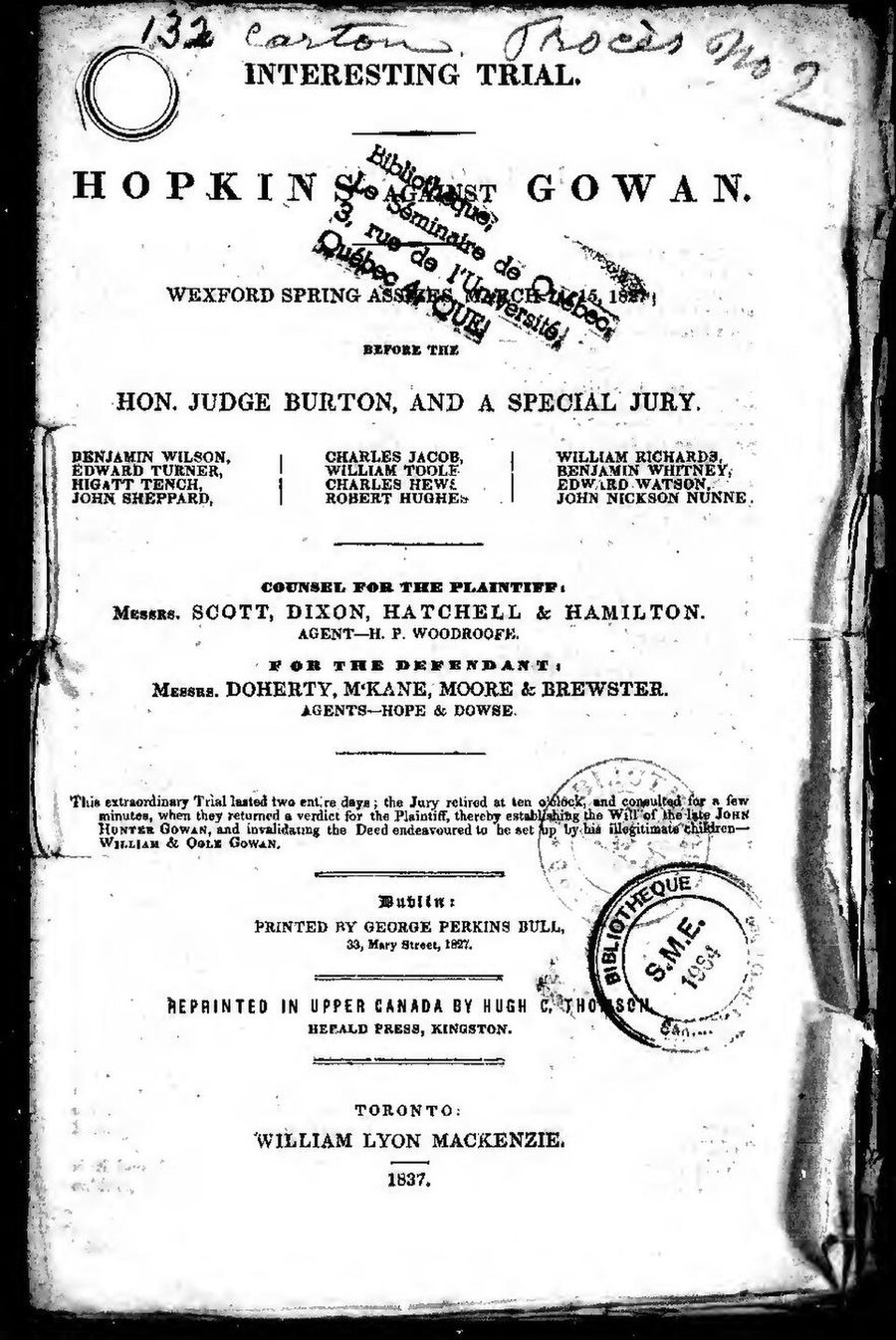
Bull had himself been imprisoned in Ireland for libelling a Catholic priest. His accusations were enough to make the Montreal Orangemen repudiate Gowan in the 1830s and were recirculated by his enemies for decades afterward, though Senior records that they made no impression on Gowan’s friends or on the public.
The schism that followed was real. Benjamin’s defeated supporters set up a rival grand lodge and charged Gowan with subordinating the lodges to politics, which was true and was also true of them. Of 563 Canadian lodges, 106 went with Benjamin; every Maritime lodge stayed with Gowan. Ordinary members disliked the whole business, and in 1856 Gowan stepped down so the two bodies could reunite under George Lyttleton Allen, the long-serving grand secretary. He had won the fight and given up the prize.
The last elections
He lost Ontario North in 1854, which forced him to sell the Patriot to James Beaty, who folded it into the Leader. He lost Ontario North again in 1857, this time to local Orangemen who said he had been sold to the Pope. He won a North Leeds by-election in the spring of 1858, campaigning on his own revision of George Brown’s slogan, representation by population and territory. Brown, who loathed him, called him an uncompromising adherent of the priest party while all the while professing to be an Orangeman and an extreme Protestant, and predicted no constituency would return him again.
Gowan retired from provincial politics in 1861 at fifty-eight, by then known as the father of the House. He took an inspector’s post in the post office money order department for Upper Canada, and from 1869 to 1874 served as issuer and inspector of licences for Toronto.
Structure, and a book
His last constructive work was structural, and Ontario still lives with it. At the June 1859 meeting of the Grand Orange Lodge of British America at Hamilton, Gowan proposed creating a supreme Grand Lodge with provincial grand lodges beneath it. The proposal was adopted, and at Cobourg that August, under Grand Master John Hillyard Cameron, Upper Canada was divided into the two jurisdictions that became Ontario East and Ontario West. He pushed the same idea upward: he had written to the Earl of Enniskillen as early as 1855 suggesting periodic empire-wide meetings, and saw the Imperial Grand Council founded at Belfast in 1867, having attended the preliminary conference there in 1866 for the Provincial Grand Lodge of Western Canada.
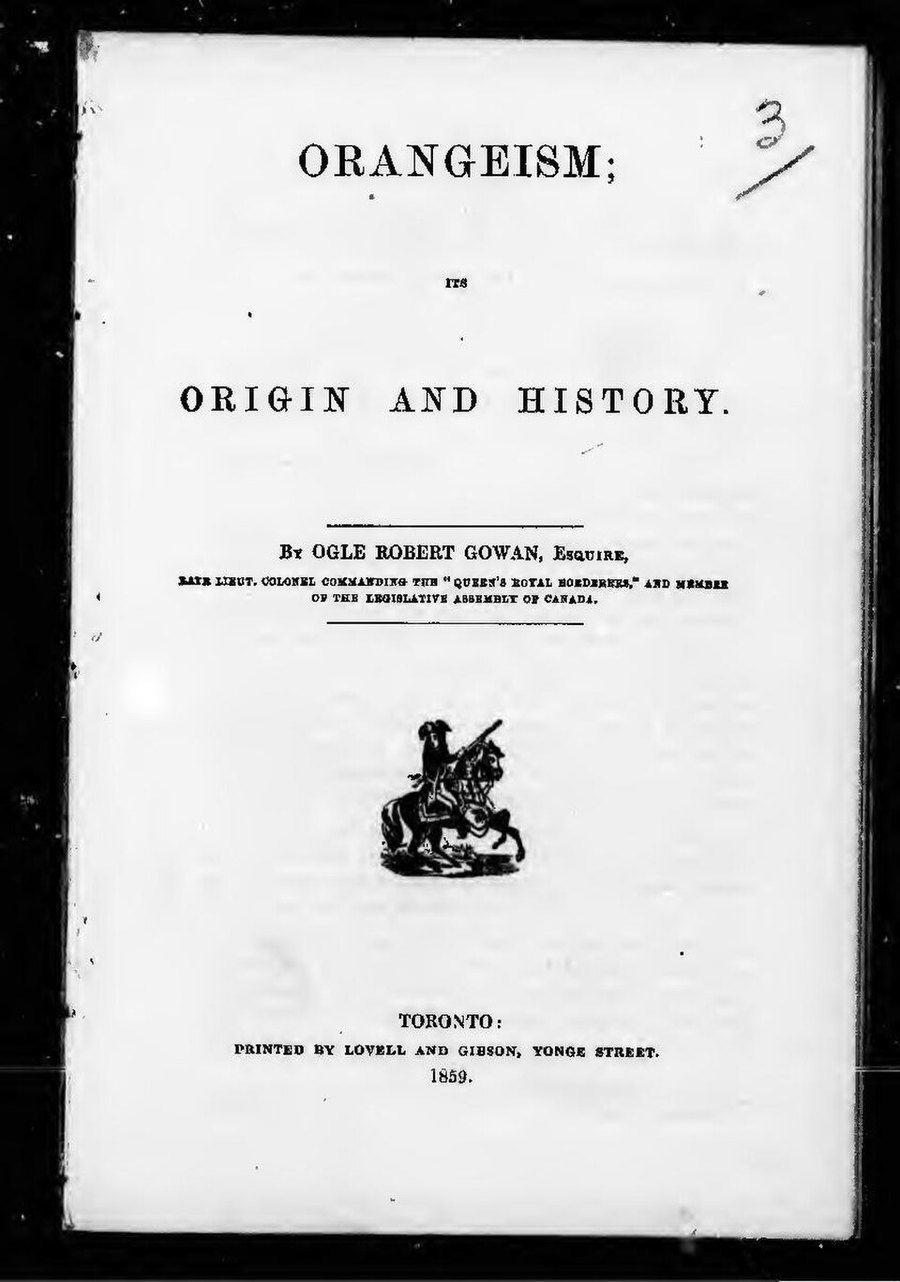
Orangeism; its Origin and History ran to three volumes published at Toronto in 1859 and 1860. The fourth volume, the one that would have covered Canadian Orangeism from the inside by the man who founded it, was never published, and the manuscript was lost. What survives is useful on Irish Orangeism and thoroughly mixed with lodge folklore.
Family and death
Gowan married Frances Anne Turner of Wexford, who died in 1852, and they had eleven children. His eldest son Nassau became a New Connexion Methodist clergyman and his son Harcourt served as grand secretary; both were prominent Orangemen, and both appear as portrait plates in Robertson’s Landmarks of Toronto alongside their father. His daughter Aliza Amelia married the Reverend William Peck of Lansdowne, and Frances Jane married Thomas Roberts Ferguson. He married Alice Hitchcock in 1866, and died at Toronto on 21 August 1876, aged seventy-three.
Senior’s verdict is worth keeping against the temptation to tidy him up. Being an Orangeman stopped barring a man from high office after about 1850, and Mackenzie, Hincks and Macdonald all recognised what Gowan could do with a crowd, yet the office never came, because Reformers and Compact Tories alike thought him not quite respectable. That reputation rested less on any proven wrongdoing than on his manner and on the endless private quarrels he pursued into court. The Order he built outlasted his standing in it by more than a century.
Trace Your Orange Roots
Surname matches, haplogroup placement, and living relatives. FamilyTreeDNA's testing kits pick up where archival records on the Gowan line end.
Affiliate links. We earn a small commission at no cost to you. Full disclosure →
Sources
- SENIOR, HEREWARD. 'GOWAN, OGLE ROBERT', Dictionary of Canadian Biography, vol. 10 (1972) — The authoritative scholarly biography, written by the historian of Canadian Orangeism. Unflattering and specific; the source of record for the dates, offices, quarrels and quotations below.
- Akenson, Donald Harman. The Orangeman: The Life and Times of Ogle Gowan. James Lorimer, 1986. — The only full-length biography. Book-length treatment of the Irish background and the Leeds machine.
- Senior, Hereward. Orangeism: The Canadian Phase. McGraw-Hill Ryerson, 1972. — Companion monograph by the same author, tracing the Order from the 1830 founding onward.
- Gowan, Ogle Robert. Orangeism; its Origin and History. Toronto: printed by Lovell and Gibson, Yonge Street, 1859. — Gowan's own history, three volumes 1859-60. Title page read from the Canadiana microform scan, August 2026. The projected fourth volume on Canadian Orangeism was never published and the manuscript was lost.
- Interesting Trial: Hopkins against Gowan, Wexford Spring Assizes, March 1827, before the Hon. Judge Burton and a Special Jury. Dublin: printed by George Perkins Bull, 1827; reprinted in Upper Canada by Hugh C. Thomson, Herald Press, Kingston; Toronto: William Lyon Mackenzie, 1837. — The trial pamphlet used against Gowan for half a century. Imprint and reprint history read directly from the Canadiana microform title page, August 2026.
- An Important Letter on Responsible Government from Lieutenant-Colonel Gowan, M.P.P. for the County of Leeds in U. Canada (microform) — The 1839 letter, in the pamphlet form Francis Hincks gave it.
- 'A Brief History', Grand Orange Lodge of Ontario — Institutional record of Gowan's June 1859 Hamilton proposal for a supreme Grand Lodge and provincial grand lodges, and the Cobourg meeting that divided Upper Canada into Ontario East and Ontario West. Read August 2026.
- Robertson, J. Ross. Robertson's Landmarks of Toronto, vol. 6. Toronto, 1914. — Carries the portrait plate opposite p. 150 and a second plate of his son Harcourt R. Gowan opposite p. 151, along with Toronto Twelfth of July reporting in which Gowan repeatedly appears as a platform speaker.
Further reading
As an Amazon Associate we earn from qualifying purchases. Full disclosure →
- The Orangeman: The Life and Times of Ogle Gowan — Donald Harman Akenson, James Lorimer, 1986. The full-length life.
- The Sash Canada Wore: A Historical Geography of the Orange Order in Canada — Houston and Smyth, 1980. Places Gowan's founding inside the settlement geography that made it stick.