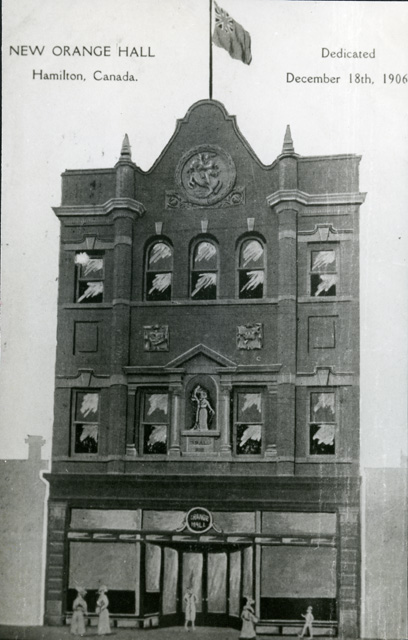
The Orange Campaign Against Clemency for Louis Riel, 1885
- Date
- 1885-08-01 — 1885-11-16
- Location
- Ontario and the District of Assiniboia, North-West Territories
Orange lodges in Ontario campaigned in 1885 to have Louis Riel hanged, not spared. This is worth stating plainly, because the phrase “Orange petition” is sometimes read the other way round. Between Riel’s conviction at Regina on 1 August 1885 and his execution on 16 November, lodges across the province passed resolutions and held public meetings pressing Sir John A. Macdonald’s government to let the sentence stand. The motive reached back fifteen years, to the death of Thomas Scott at Upper Fort Garry in March 1870.
Why Orangemen cared about Riel at all
Thomas Scott was born in the Clandeboye area of County Down in 1842 and raised a Presbyterian. He came to Canada, worked his way west, and in the winter of 1869 to 1870 fell foul of the provisional government Riel had established at Red River. Scott was tried by a court martial of that government, found guilty of defying its authority, fighting with his guards and slandering Riel, and shot by firing squad outside Upper Fort Garry on 4 March 1870.
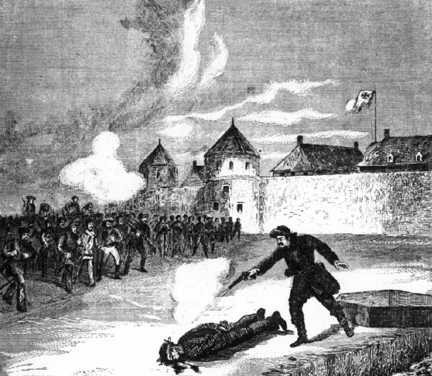
One caution belongs here, because it is repeatedly flattened in popular accounts. Scott is universally described as an Orangeman, and the Order itself claimed him as a martyr almost immediately. What survives is thinner than the claim: there is no documentary evidence that Scott ever described himself as a member. Whether or not he held a warrant in any lodge, the Order treated his death as an Orange death, and that treatment is the historical fact that matters for 1885.
The reaction in Ontario in 1870 was immediate and enormous. The Toronto Globe wrote that Scott had been murdered by the enemies of the Queen, country and religion. Mass meetings demanded that Ottawa act. The Wolseley Expedition marched west later that year. In April 1874, Mackenzie Bowell, then in his fourth year as Grand Master of the Loyal Orange Association of British America and member for Hastings North, moved in the Commons for Riel’s expulsion from the House. By 1885 Bowell was Minister of Customs in Macdonald’s cabinet, which put a past Grand Master of the Order at the table where clemency would be decided.
What the courts actually did in 1885
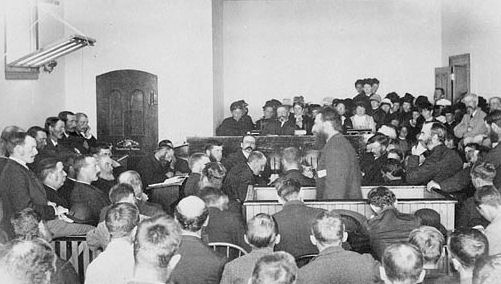
Riel’s trial opened at Regina on 20 July 1885 and ran to 1 August. Jury selection began on 28 July. He faced six counts of high treason laid under the English Treason Act of 1351, a statute that carried a mandatory death sentence on conviction and gave the court no sentencing discretion at all.
The bench was not a superior court, a point Riel’s counsel contested unsuccessfully. Stipendiary magistrate Hugh Richardson presided, assisted by justice of the peace Henry Le Jeune. The jury numbered six rather than the usual twelve, all of them English-speaking Protestants drawn from the southern part of the District of Assiniboia. Of thirty-six jurors summoned, one spoke French and could not attend, and the only Roman Catholic was excluded by the prosecution.
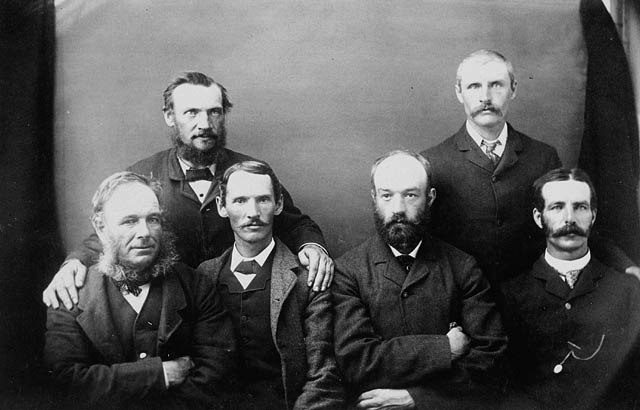
The six names are worth recording, because they are hard to find collected anywhere outside the archival caption on Buell’s photograph: Francis Cosgrave of Whitewood, who served as foreman, William Merryfield, Edwin J. Brookes, P. Deane, Harry J. Painter and Ed Evatt.
They deliberated for one hour and twenty minutes and returned a guilty verdict on 1 August 1885, with a unanimous recommendation for mercy. Cosgrave was reported to be in tears as he delivered it. Richardson sentenced Riel to hang, the only sentence the statute allowed. That combination, a conviction carrying a mandatory death sentence alongside a jury that had explicitly asked for mercy, is what threw the question to the cabinet in Ottawa and opened the four months of public agitation that followed.
What did the Orange lodges actually do?
This is the part where the popular account runs well ahead of the documentation, so it is worth separating the two.
What is well established is the direction and the temperature. Ontario Orangeism wanted Riel hanged, wanted it for Scott rather than for the events of 1885, and said so loudly through the autumn. Lodges passed resolutions. Public meetings were held. The Order’s position was reported in the Protestant press and understood by everyone in the cabinet. A juror interviewed decades afterwards put the whole affair in one sentence that has been quoted ever since: “We tried Riel for treason, and he was hanged for the murder of Scott.”
What is less well established, and what this page will not assert, is any single consolidated “Orange petition” of 1885 with a known text, a known signature count and a known date of presentation. The Order had done exactly that sort of thing before. In the 1870s its Grand Master of British North America, John Hillyard Cameron, carried a petition on the Scott killing to Queen Victoria, who set it aside. No comparable single document for 1885 has been verified for this page. The 1885 campaign as documented was a distributed one, conducted lodge by lodge and county by county, which is precisely why it left its traces in local minute books and county newspapers rather than in one file in Ottawa.
Anyone researching a particular lodge’s part in it should expect to find it in that lodge’s own minutes for the autumn of 1885, if they survive, and in the columns of the county paper. This site would welcome transcriptions.
The government’s decision
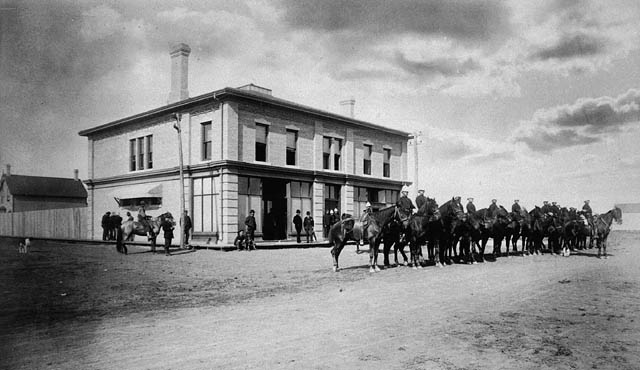
Macdonald’s cabinet appointed a medical commission to examine Riel’s sanity, and the execution date was moved more than once while the question was considered. The pressure ran hard in both directions at once: Quebec wanted commutation and Ontario, with the lodges at the front of it, wanted none. Macdonald’s own summary of where he landed has outlived every other sentence spoken about the affair. Riel, he said, would hang though every dog in Quebec should bark in his favour.
Riel was hanged at Regina on 16 November 1885, in the North-West Mounted Police barracks there.
What it cost the government
The Orange lodges got the outcome they had pressed for, and the Conservative party paid for it for a generation.
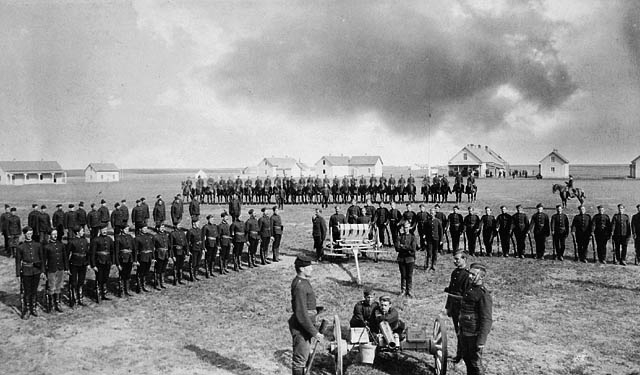
The Parti National was organised in Quebec on 17 November 1885, the day after the execution. On 22 November a crowd reported at fifty thousand gathered on the Champ de Mars in Montreal to hear Honoré Mercier and Wilfrid Laurier. Mercier’s Parti National took a majority at the Quebec election of 1886, largely at the expense of the provincial Conservatives, and the realignment it began carried Laurier into national office in 1896.
For the Order the 1885 campaign was a demonstration of reach rather than a turning point. Its Canadian membership was still climbing and would peak around 1920 at roughly two thousand lodges and a hundred thousand members across Canada and Newfoundland. The same organisational machinery that carried resolutions on Riel through hundreds of lodge rooms in the autumn of 1885 was turned on the Jesuit Estates Act four years later, and the two agitations are best read together.
Where to look for the records
Lodge minute books are the primary evidence and they are scattered. Ontario lodges west of the western boundary of Victoria County fell under the Grand Orange Lodge of Ontario West, and their surviving records are described in the 1871 directory of Orange lodges in western Ontario on this site. County and municipal archives hold most of what survives, along with a substantial deposit at Western University for the southwestern counties.
For the trial itself, Library and Archives Canada holds Oliver Buell’s photographic record of Regina in 1885, including the courthouse, the jury and the barracks, all of it public domain. For the Ontario reaction, the county newspapers of September to November 1885 are the fastest route to named local participants, which is what most researchers arriving at this page are actually after.
Trace Your Orange Roots
Surname matches, haplogroup placement, and living relatives. FamilyTreeDNA's testing kits pick up where archival records end.
Affiliate links. We earn a small commission at no cost to you. Full disclosure →
Sources
- Trial of Louis Riel, Wikipedia — Trial dates, the six counts under the Treason Act 1351, Judge Hugh Richardson, the six-man jury and its recommendation for mercy. Verified August 2026.
- Thomas Scott (Orangeman), Wikipedia — Scott's origins in County Down, the 4 March 1870 execution at Upper Fort Garry, and the caution that no evidence survives of Scott himself claiming Orange membership. Verified August 2026.
- Orange Order in Canada, Wikipedia — Lodge and membership figures, and the Order's involvement in the response to the 1870 and 1885 risings. Verified August 2026.
- The jury of six at Louis Riel's trial, Library and Archives Canada, MIKAN 3406975 — Photograph by Oliver B. Buell, August 1885. The archival caption names all six jurors, the only convenient source for the full list. Verified August 2026.
- Parti National (Quebec), Wikipedia — Founding on 17 November 1885, the Champ de Mars assembly of 22 November, and the 1886 Quebec election result. Verified August 2026.
- Fraternal and Benevolent Societies in Ontario: Loyal Orange Order — Fraser Dunford's reference on Ontario lodge structure, provincial grand lodge boundaries and lodge numbering. Verified August 2026.
Further reading
As an Amazon Associate we earn from qualifying purchases. Full disclosure →
- The Sash Canada Wore: A Historical Geography of the Orange Order in Canada — Houston and Smyth, 1980. The standard scholarly account of the Order's Canadian membership and geography.
- The Orange Order in Canada — David A. Wilson (ed.), Four Courts Press, 2007. Essay collection covering the Order's political interventions.
- Louis Riel — George F. G. Stanley, Ryerson Press, 1963. Still the standard scholarly biography for the 1885 events.