The Royal Black Preceptory in Canada
The Royal Black Preceptory is not a branch of the Orange Lodge. It is a separate order, and a man could not join it directly. He had first to be an Orangeman and to have taken the Royal Arch Purple degree, at which point he became eligible for the Black. Its local unit is a preceptory rather than a lodge, its members are addressed as Sir Knight, and its Canadian governing body, the Grand Black Chapter of British America, was constituted at Toronto in 1874. Preceptories had been working in the colonies for roughly forty-five years before that, on warrants carried over individually from Ireland.
For anyone tracing an ancestor, the practical consequence is this: a Black preceptory number and an Orange lodge number are different numbers in different series, and a man who appears in both records is one man, not two.
Where the order came from
The Royal Black Institution was established in Ireland in September 1797, two years after the Orange Order was founded at the Diamond in County Armagh. Independent Black preceptories existed before the Grand Black Chapter of Ireland gave them a common governing body. In its earliest Canadian appearances the order is sometimes recorded under the older name, the Royal Black Association of the Knights of Malta, which is one reason the nineteenth-century paper trail can look more tangled than it is.
The order describes itself, and is generally described, as the senior of the loyal orders. It is not senior in the sense of governing the others. The Orange Order, the Royal Arch Purple and the Royal Black Institution are three separate bodies with three separate sets of books, connected by the requirement that membership runs in that sequence.
The eleven degrees
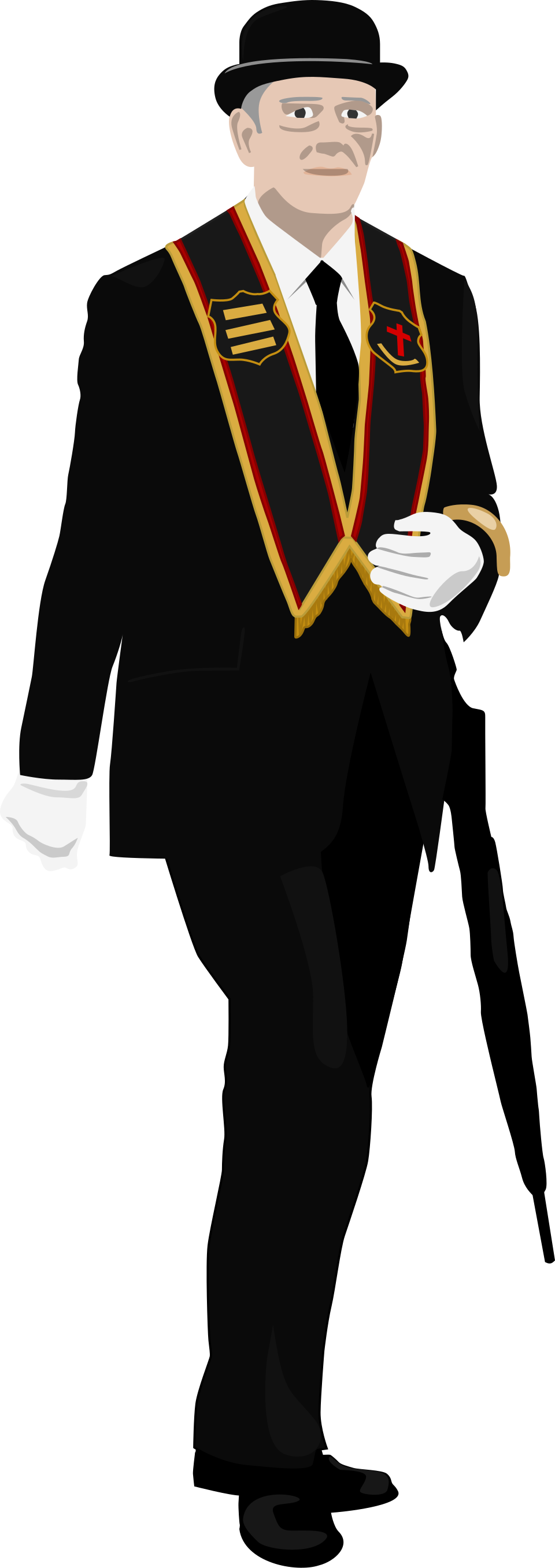
The Black works eleven degrees, conventionally listed in descending order: Royal Black, Royal Scarlet, Royal Mark, Apron and Royal Blue, Royal White, Royal Green, Gold, Star and Garter, Crimson Arrow, Link and Chain, and Red Cross. A twelfth, retrospective degree summarises the other eleven.
This matters for record-reading. A minute book entry recording that a man “received a degree” on a given date, as the Owen Sound preceptory recorded of John A. Thomson on 9 May 1913, is recording one step in a long progression, not an initiation. The same man may appear in the same book a dozen times across a decade.
Do not confuse these with the four degrees worked by the Orange Order in Canada, which are Orange, Royal Blue, Royal Arch Purple and Royal Scarlet. The names overlap and the systems do not.
When was the Canadian body founded?
The date usually given is 1874, at Toronto, under the name Grand Black Chapter of British America. That is the date in the standard reference works and in Fraser Dunford’s Ontario survey, which arrive at it independently, and the body later became the Grand Black Chapter of Canada.
One well-regarded source disagrees. Historic Nova Scotia gives 1871. This page has not been able to reconcile the two, and rather than pick silently, both are recorded here. Anyone working from a Nova Scotia preceptory’s own records should be aware that the earlier date circulates in the provincial literature.
There is firmer ground on the arrival of the order itself. The Blacks were working in Canada from about 1829, carried in by individual Irish and Scottish emigrants holding warrants from home, and predating any Canadian governing structure by several decades. Some secondary accounts name a Saint John, New Brunswick preceptory of 1848 and a Toronto preceptory of 1854 as the first two, but this page has not verified either against a primary source and does not assert them.
Preceptory structure and officers
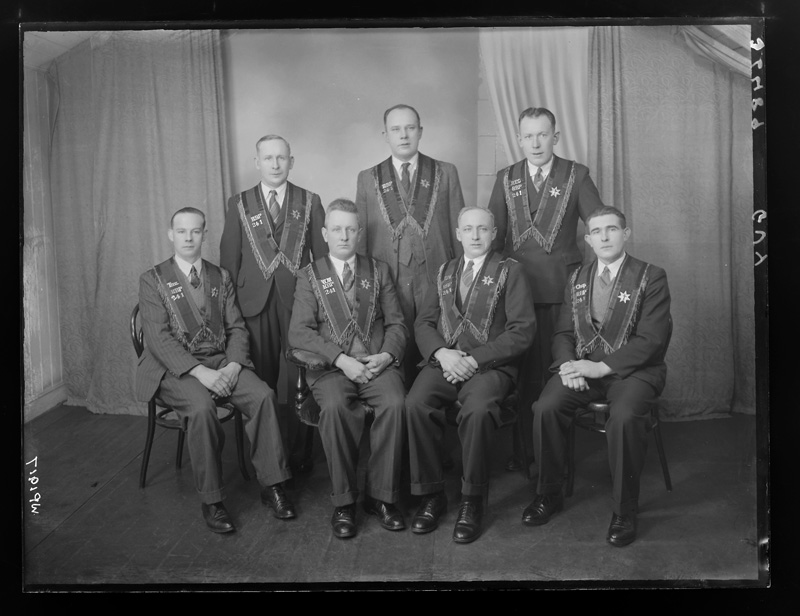
A preceptory is headed by a Worshipful Preceptor, the equivalent of a lodge master or president, with a Secretary and a Chaplain among the other offices. Preceptories group into district and county chapters, those into provincial chapters, and those into the national Grand Black Chapter. Over the whole structure sits the Imperial Grand Black Chapter.
Nova Scotia’s arc is the best-documented provincial sequence available. There were twelve active preceptories in the province in 1907. A Nova Scotia Provincial Chapter was formed in 1911. The count reached fifteen preceptories by 1925, fell to thirteen with 354 members between them in 1955, ten by 1961 and seven by 1979. The Provincial Chapter ceased to exist in 2007, and there are no Royal Black Preceptories in Nova Scotia now.
Pioneer RBP 117 at Shubenacadie, in Hants County, had twenty members in 1907. Its burial of Sir Knight David Scott Killen, who died on 4 October 1889 aged twenty-nine, at Londonderry, is the sort of entry that makes preceptory records worth chasing: fraternal orders buried their members, and the burial is often recorded where the civil record is thin.
Reading a Canadian preceptory number
Preceptory numbers repeat. They repeat for the same reason Orange lodge numbers repeat, and the mechanism is worth understanding before drawing any conclusion from a number alone.
In a parade the units march in number order, so a low number puts a preceptory near the front. When a preceptory folded, its number became available, and surviving higher-numbered bodies competed to take it. The result is that a single number can belong to two different preceptories in two different places at two different times.
The Ontario list shows it plainly. RBP 111 appears at Streetsville, then moves to Brampton in 1915 and appears there as Rev. Canon Walsh RBP 111. Number 117 belongs to Pioneer at Shubenacadie in Nova Scotia and to a differently named body in the Ontario series. Do not assume that two records carrying the same preceptory number describe the same organisation without checking the place.
Some Ontario preceptories, with the date range of the records noted where a range is known:
| No. | Name | Place | Note |
|---|---|---|---|
| 34 | Bolton | Dormant in 1866 | |
| 41 | King Solomon | Toronto | |
| 96 | Maiden | Toronto | Records to 1903 |
| 110 | Sand Hill | Dormant in 1866, active again by 1874 | |
| 111 | Streetsville | Moved to Brampton in 1915 | |
| 111 | Rev. Canon Walsh | Brampton | From 1915 |
| 126 | Mono Mills, Peel County | From 1874 | |
| 261 | Peterborough | 1866 to 1972 | |
| 278 | Elgin | St Thomas | Records to 1922 |
| 292 | Temple | Toronto | Records to 1903 |
| 346 | Covenant | London | Records to 1922 |
| 403 | Jasper | Palgrave | 1899 to 1936 |
| 419 | Owen Sound, Grey County | Instituted 15 September 1888 | |
| 834 | Inniskillin | London | Records to 1922 |
| 912 | Lord Erne | Chatham | Records to 1969 |
| 937 | King Solomon | London | Records to 1922 |
| 956 | Langemark | London | Records to 1922 |
The number of Canadian preceptories across the whole history of the order is usually given as about 160, a figure that recurs in local museum descriptions. A separate figure of 160 currently operating preceptories across six Canadian district chapters, seventy-three of them in Newfoundland, also circulates. The two are different claims that happen to share a number, and neither has been verified here against the order’s own returns.
A documented preceptory: Owen Sound, No. 419
Royal Black Preceptory No. 419 was instituted at Owen Sound, Grey County, on 15 September 1888. It met on the second and fourth Mondays of each month in the Orange Hall, which is the usual arrangement: preceptories rarely owned premises and generally sat in the local Orange hall on a different night from the lodge.
Around 1922 its Worshipful Preceptor was N. Dean and its Registrar was Alfred Kirk. John A. Thomson received a degree in the preceptory on 9 May 1913. Robert McLernon is also recorded as a member. Those four names, with a date attached to one of them, are a fair sample of what a well-kept preceptory record yields, and it is more than most Canadian preceptories have left behind.
Where the records are
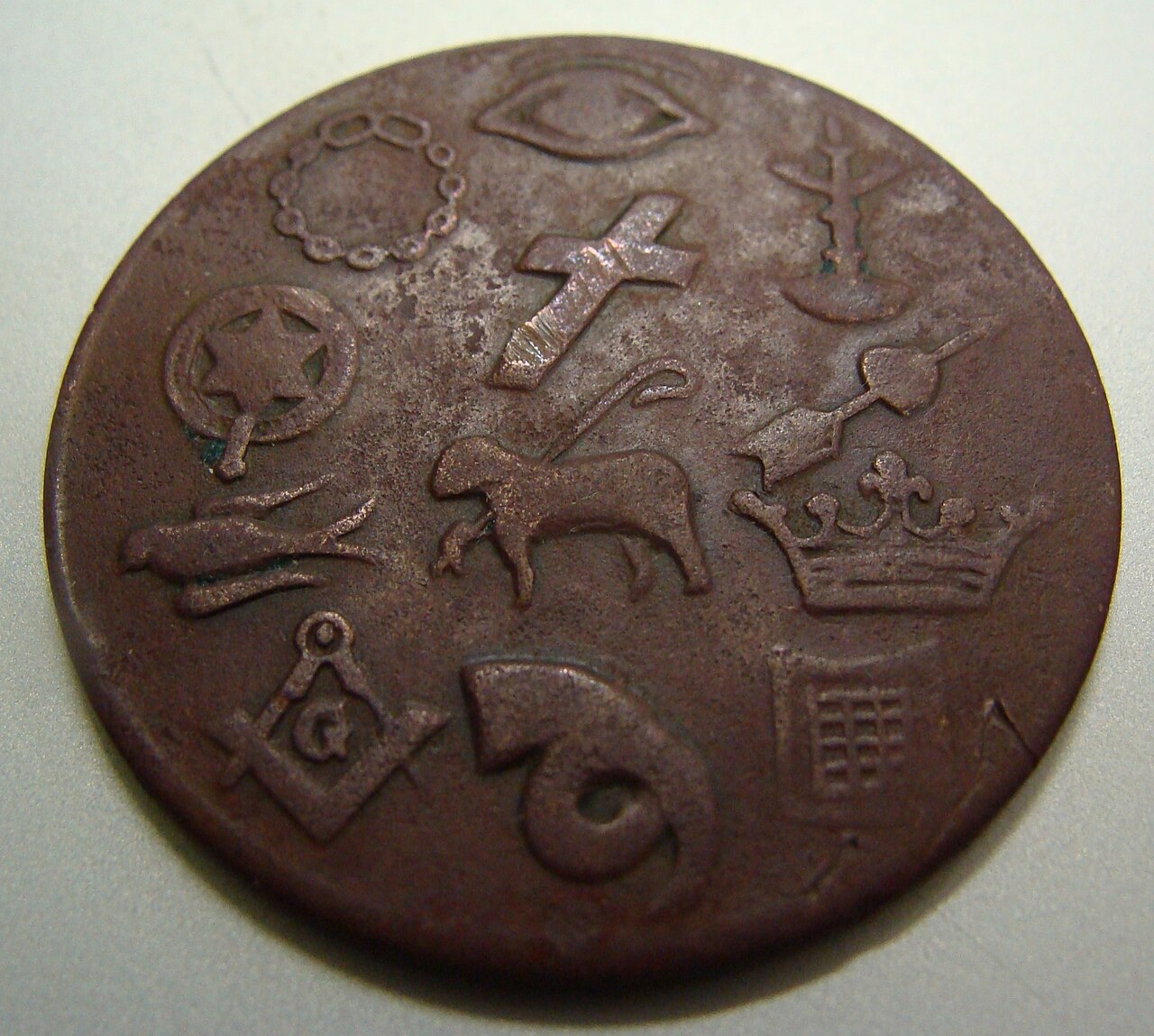
Black records survive in the same places as Orange lodge records and are usually thinner. County and regional museums hold most of what exists: Grey Roots at Owen Sound, Bruce County Archives, the Deseronto Archives in Hastings County, whose penny token appears at the head of this page.
Three practical notes for searching. Preceptory records are frequently catalogued under the Orange Order rather than separately, because the same men and often the same building were involved. A preceptory that met in an Orange hall may leave its only trace in that hall’s records. And because the order’s name changed and its Maltese offshoots split away in the nineteenth century, a catalogue search should also try Knights of Malta, Royal Black Association of the Knights of Malta, and Royal Grand Black Maltese Encampment.
The related Knights of Malta bodies are genuinely confusing and worth separating. An organisation of that name was established at Montreal around 1841, with a further warrant issued for Hornby, near Toronto, in July 1844. The American branch later severed its Orange connection, moved its head office to Toronto as the Knights of St John and Malta, and ceased in 1910. A faction that left in 1906 became the Order of Knights Hospitaller. Those that stayed connected to the Orange Order became the Ancient and Illustrious Order of the Knights of Malta. None of these is the Royal Black Institution, and all of them turn up in the same catalogues.
For the wider institutional setting, see the Orange Order in Canada, and for the parade calendar in which preceptories were most publicly visible, Orangemen’s Day.
Trace Your Orange Roots
Surname matches, haplogroup placement, and living relatives. FamilyTreeDNA's testing kits pick up where archival records end.
Affiliate links. We earn a small commission at no cost to you. Full disclosure →
Sources
- Royal Black Institution, Wikipedia — Founding in September 1797, the eleven degrees in descending order, the Royal Arch Purple prerequisite, and the 1874 constitution of the Grand Black Chapter of British America at Toronto. Verified August 2026.
- Fraternal and Benevolent Societies in Ontario: Loyal Orange Order — Fraser Dunford's reference. Independently gives 1874 for the Grand Black Chapter of British America, the 1829 arrival of the Blacks in Canada, the Purple-degree prerequisite, and the Knights of Malta offshoots. Verified August 2026.
- Royal Black Preceptories in Ontario, Fraternal and Benevolent Societies in Ontario — Working list of Ontario preceptory numbers, names, locations and record date ranges. The source for the preceptory table on this page. Verified August 2026.
- The Black Knights of Nova Scotia, Historic Nova Scotia — Nova Scotia preceptory counts from 1907 to 2007, Pioneer RBP 117 at Shubenacadie, and the preceptory officer titles. Gives 1871 rather than 1874 for the Canadian founding, the discrepancy noted on this page. Verified August 2026.
- Royal Black Preceptory No. 419 (Owen Sound), Grey Roots Museum and Archives — Institution date of 15 September 1888, meeting schedule, and named members including John A. Thomson and Alfred Kirk. Verified August 2026.
Further reading
As an Amazon Associate we earn from qualifying purchases. Full disclosure →
- The Sash Canada Wore: A Historical Geography of the Orange Order in Canada — Houston and Smyth, 1980. Covers the loyal orders as a family rather than the Orange lodge in isolation.
- The Orange Order in Canada — David A. Wilson (ed.), Four Courts Press, 2007.